
An Intrepid Explorers Review — October 2026
Cybersecurity is entering a new phase of risk. Artificial intelligence is accelerating attacks, machine identities and autonomous agents are expanding internal security exposure, and software vulnerabilities are being exploited faster than many organizations can respond. Meanwhile, cybersecurity professionals face persistent skills shortages, growing operational demands, and increasingly complex governance responsibilities.
Looking back over approximately eighteen months of cybersecurity reporting, these developments no longer appear to be isolated threats. They are becoming interconnected weaknesses in the digital infrastructure upon which modern commerce depends. A further concern is emerging: could inadequate cybersecurity resilience eventually undermine an enterprise’s financial standing and even contribute to corporate failure?
The important question is whether organizations are developing the defensive capabilities, human expertise, and governance arrangements necessary to keep pace.
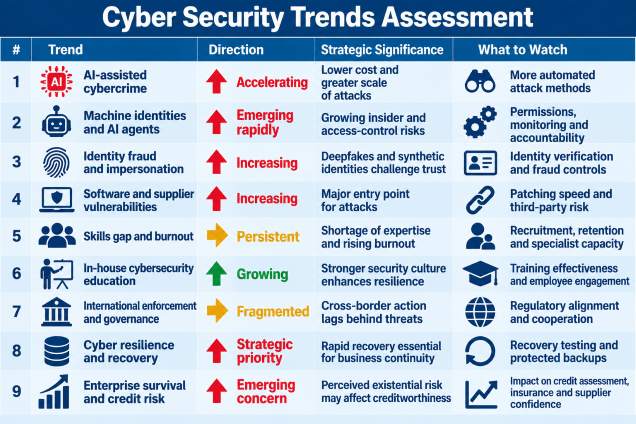
Cyber Security Trends Assessment — October 2026
Our review identifies nine developments influencing the cybersecurity landscape. The accompanying assessment reflects their direction and strategic significance rather than statistically measured growth rates. The analysis below examines the evidence, implications for businesses, and questions requiring further investigation.
The Threat Landscape Is Changing
For many years, cybersecurity focused heavily on protecting networks from external intrusions. Firewalls, antivirus software, encryption, and access controls formed the foundation of corporate defenses. These remain essential, but the nature of the threat is changing.
Verizon’s 2026 Data Breach Investigations Report identifies exploitation of software vulnerabilities as a major initial entry point in breaches, alongside stolen credentials. Ransomware remains widespread, while attacks exploiting third-party relationships expose weaknesses beyond an organization’s immediate control.
At the same time, criminals are adopting artificial intelligence to accelerate reconnaissance, identify vulnerabilities, improve social engineering, and automate fraudulent activities. The result is not simply more sophisticated attacks. It is a compression of the time available for organizations to identify and respond to emerging threats.
This development has particular significance for small and medium-sized enterprises, many of which depend heavily on external technology providers and lack the internal expertise required to evaluate rapidly changing security risks.
Artificial Intelligence: The Expanding Internal Threat
One of the most striking developments concerns the rapid growth of machine identities and autonomous AI agents.
A recent Cyber Security Intelligence article, Guarding Against Insider Threats in an AI World, highlights research suggesting that machine identities now outnumber human workers by 109 to one.
The figure requires careful interpretation. Machine identities include service accounts, applications, workloads, and other non-human credentials—not simply autonomous robots or AI agents. Nevertheless, it illustrates the scale of the identity-management challenge.
Historically, insider threats were associated with employees who intentionally or accidentally compromised security. Autonomous AI systems introduce another dimension. An AI agent may access confidential information or execute transactions using permissions inherited from its human operator, even when its actions produce unintended consequences.
This raises a fundamental governance question: Do organizations know precisely which machine identities have access to their information, what those identities are permitted to do, and who remains accountable for their actions?
As businesses accelerate AI deployment, identity governance, restricted permissions, continuous monitoring, and reliable audit trails become increasingly important.
Cybercrime and Fraud Are Converging
Our earlier reviews examined the industrialization of cybercrime and the growing importance of identity verification. These trends are now becoming inseparable.
AI-assisted impersonation, synthetic identities, deepfake communications, and business email compromise exploit weaknesses in both technological defenses and human judgment.
Fraud prevention can no longer be treated exclusively as a financial-services function. It increasingly concerns procurement, customer onboarding, supplier verification, payments, and internal authorization procedures across the entire enterprise.
Beyond direct fraud losses, organizations face operational interruptions, investigation costs, reputational damage, and declining confidence among customers and business partners.
The distinction between cybersecurity and fraud prevention is consequently becoming less meaningful. Both depend on reliable identities, trustworthy information, effective controls, and informed decisions.
The Human Capacity Problem Remains Unresolved
Perhaps the most persistent concern throughout our reporting has been the shortage of qualified cybersecurity professionals.
Earlier ISC2 research estimated a global cybersecurity workforce gap of 4.8 million. More recent research emphasizes continuing shortages of specialized skills, particularly as artificial intelligence creates additional responsibilities for security teams.
The problem cannot be resolved through recruitment alone. Educational institutions require time to develop qualified professionals, while existing specialists must continually adapt to new technologies and increasingly demanding workloads.
Burnout adds another complication. Experienced professionals are particularly valuable because effective cybersecurity depends not only on technical qualifications but also on judgment developed through practical experience.
This reinforces a conclusion discussed in our earlier editorial, Cyber Security’s Future Depends on People, Not Technology.
Organizations must invest in internal education and develop a cybersecurity culture extending beyond specialist departments. Employees, management, risk professionals, and boards must understand their responsibilities within the organization’s security framework.
A cybersecurity safety net built around informed people, appropriate technology, and effective governance offers greater resilience than dependence on technology alone.
Governance and Recovery Become Strategic Priorities
The growing autonomy of AI systems exposes limitations in existing governance arrangements.
Traditional security reviews were designed around relatively predictable changes to software, personnel, and infrastructure. AI agents can operate continuously, interact with multiple applications, and execute tasks at speeds that make conventional review cycles increasingly inadequate.
Organizations must establish boundaries for autonomous systems, maintain oversight of privileged access, and ensure that critical decisions remain subject to appropriate human control.
Recovery deserves equal attention. Recent Cyber Security Intelligence reporting emphasized the importance of isolated backups and recovery environments protected from compromised accounts and automated systems.
This reflects a broader change in cybersecurity thinking. Preventing every attack may be unrealistic. Preserving the ability to recover quickly and maintain essential operations is therefore becoming a fundamental measure of organizational resilience.
International cooperation remains another unresolved challenge. Cybercriminal networks operate across national borders, while investigation, prosecution, and enforcement continue to depend on fragmented legal and political arrangements.
Cybersecurity as an Existential Threat: Perception, Evidence and Credit Risk
Perhaps the most consequential development in our review is the growing perception that a serious cyberattack could threaten the survival of an enterprise.
Research published by Databarracks in June 2026 found that 65% of surveyed IT decision-makers believed a serious cyberattack could threaten their organization’s survival. This is a significant indication of changing attitudes toward cybersecurity risk. However, an important distinction must be made: perceived existential risk is not evidence of actual corporate failures caused by cyberattacks.
Establishing that relationship presents a considerable challenge. A cyberattack may disrupt operations, damage customer relationships, undermine supplier confidence, and create financial pressures that eventually contribute to insolvency. Yet bankruptcy records do not necessarily identify cybersecurity incidents among the underlying causes of business failure.
This raises an important question for the credit information and rating industry. Are existing corporate risk assessment systems capable of identifying cybersecurity weaknesses as contributing factors to financial distress or corporate failure?
The industry is particularly well positioned to investigate this relationship, given its experience in assessing payment behavior, financial condition, management performance, and operational risk. Nevertheless, distinguishing a cyberattack as the principal cause of insolvency from one of several contributing factors may prove difficult.
The problem extends beyond companies that ultimately fail. Organizations struggling with shortages of qualified cybersecurity personnel, employee burnout, inadequate recovery capabilities, or repeated security incidents may experience deteriorating operational resilience long before financial distress becomes visible.
Lenders, insurers, suppliers, and customers have legitimate reasons to consider these exposures when evaluating counterparties. Whether cybersecurity weaknesses are already influencing credit decisions on a measurable scale remains an important question for further research.
The emerging challenge is not simply to recognize cybersecurity as a potential existential threat, but to develop reliable information that distinguishes perceived risk, demonstrated operational vulnerability, and actual financial consequences. This would be highly relevant in the assessment of the probability of a potential Domino Effect within supply chains.
For the credit information industry, that distinction may become increasingly important as cybersecurity develops into another dimension of corporate risk assessment.
What Should We Watch Over the Next Three Years?
The evidence suggests that several developments deserve particular attention.
The growth of autonomous AI agents will make machine-identity governance increasingly important. The convergence of cybercrime and financial fraud will place greater pressure on identity verification and information integrity. Vulnerability exploitation and third-party exposure will require faster responses and more rigorous supplier oversight.
The persistent shortage of experienced cybersecurity professionals will increase the importance of in-house education, workforce retention, and organizational culture. Meanwhile, boards and management will increasingly be judged not simply by their cybersecurity investments but by their organizations’ ability to withstand and recover from major incidents.
A further question now deserves a place in future cybersecurity assessments: Can weaknesses in cyber resilience be identified as early indicators of corporate financial distress?
That question is particularly relevant to credit information providers, rating agencies, insurers, and financial institutions. It may require combining cybersecurity incident data with financial information, payment experiences, business-continuity assessments, and insolvency records.
These developments do not necessarily mean defenders are losing every battle. Security technologies continue to improve, and organizations are becoming more sophisticated in their response.
But the evidence points to a growing imbalance between the speed at which new digital capabilities are deployed and the speed at which their associated risks can be understood and controlled.
Conclusion
During the past eighteen months, cybersecurity has evolved from a largely technical concern into a broader question of enterprise governance, operational resilience, and trust.
The expanding role of AI agents, the convergence of fraud and cybersecurity, and the persistent shortage of experienced professionals suggest that organizations must reconsider how responsibilities are distributed throughout their operations.
A recent Cyber Security Intelligence observation deserves repeating: “The idea that a cyber attack could be existential is no longer a fringe view.”
That recognition marks an important turning point. Cybersecurity is no longer simply about protecting digital assets; it is about protecting the continuity and resilience of the enterprise itself.
However, recognizing the possibility of existential risk is only the beginning. The next challenge is to establish whether—and under what circumstances—cybersecurity weaknesses contribute to financial distress and corporate failure.
For the credit information industry, this presents a potentially important new field of investigation. The industry’s experience in evaluating business risk could help distinguish between perceived threats, actual vulnerabilities, and measurable financial consequences.
Cybersecurity is becoming a test not only of how well organizations protect their systems, but of how well they understand and manage the risks of their own digital transformation. The ability to measure those risks may ultimately become as important as the ability to defend against them.
 Source: Intrepid Explorers, LLC monitors cyber securty risk factors. We select specific articles with data which indicate significant trends. We conduct regular research which is supported by ChatGPT.
Some of recent Intrepid articles which help establish the emerging pattern
AI is changing the economics of cybercrime, not merely introducing new attack techniques.
Autonomous agents require identity controls, restricted permissions, monitoring, and human accountability.
Practical, department-specific training becomes essential rather than relying on annual compliance exercises.
A 2026 survey reports that 65% of respondents believe a serious cyberattack could threaten their organization’s survival.