
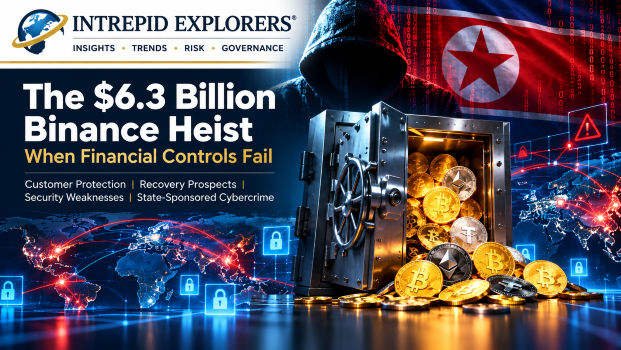
Customer protection, prospects for recovery, security weaknesses and the challenge of state-sponsored cybercrime
The theft of approximately $6.3 billion in cryptocurrency from Binance on October 29, 2026, raises questions extending far beyond the cryptocurrency industry. The world’s largest cryptocurrency exchange suffered what investigators describe as the largest recorded digital-asset theft, with most of the funds transferred within approximately 20–30 minutes.
The incident raises four fundamental questions: What happens to customers? Can the losses be recovered? Where did security fail? And how can governments prevent North Korea from turning cybercrime into a source of state financing?
Customer Protection: Who Bears the Loss?
Binance has promised to compensate customers, stating that more than $6.34 billion in company resources has been reserved to cover the incident. Approximately $3 billion of stolen assets has reportedly been frozen, largely through intervention by stablecoin issuers.
However, frozen assets are not necessarily recovered assets. Customers also face restrictions on withdrawals, market volatility and uncertainty over when normal operations will resume.
The essential question is whether Binance can independently demonstrate that it possesses sufficient liquid resources to meet all customer obligations. Its assurances need to be supported by independently verified financial information.
Prospects for Recovery
Blockchain investigators have demonstrated that stolen cryptocurrency can be traced across multiple networks. Tether, Circle and other issuers were able to freeze substantial amounts of stolen tokens within minutes.
Nevertheless, billions remain in cryptocurrencies that cannot be frozen by a central issuer. Their eventual recovery will depend on international cooperation, tracing capabilities and intervention when criminals attempt to exchange them for usable funds.
A recovery in cryptocurrency market prices is a separate question. Restoring investor confidence will require credible evidence that the security weaknesses have been corrected.
Where Did Security Fail?
Initial investigations indicate that attackers compromised an engineer’s laptop and exploited weaknesses in Binance’s transaction authorization infrastructure. The attackers apparently succeeded in inducing systems to authorize withdrawals without necessarily obtaining customers’ private cryptographic keys.
The distinction is critical. Sophisticated encryption offers limited protection when the processes authorizing transactions can be compromised.
This raises questions about privileged employee access, separation of duties, independent transaction approvals, wallet security and the effectiveness of real-time monitoring.
The underlying issue is not simply technological sophistication. It is whether internal controls were proportionate to the enormous value of assets entrusted to the institution.
North Korea: Cybercrime as State Financing
Blockchain investigators have linked the attack with high confidence to North Korea’s TraderTraitor operation, although final attribution remains subject to investigation.
North Korea has developed sophisticated cyber capabilities and repeatedly targeted financial institutions and cryptocurrency exchanges. The proceeds are believed to support the regime’s foreign-currency requirements and military programmes.
Traditional sanctions alone cannot prevent such thefts. A more effective response requires stronger cybersecurity standards, internationally coordinated transaction monitoring, rapid identification of suspicious wallets, cooperation between financial intelligence authorities and restrictions on the conversion of stolen assets into usable funds.
The objective should be to make the theft, movement and monetization of cryptocurrency progressively more difficult.
The Wider Implications for Financial Governance
The Binance incident illustrates a familiar principle in financial risk management: technological innovation does not eliminate the need for reliable information, internal controls and independent oversight.
For the business-information industry, the relevance is clear. Identifying counterparties, understanding beneficial ownership, monitoring transactions and assessing operational and financial risks remain essential, regardless of the technology used to transfer value.
The critical question for regulators is whether cryptocurrency exchanges holding billions in customer assets should be subject to independently verified custody, financial-resource and operational-risk standards comparable in effectiveness to those expected of other major financial intermediaries.
The lesson is not simply that cybercriminals have become more sophisticated. It is that financial institutions must demonstrate that their governance and controls are keeping pace with the risks they have undertaken.
Sources and further reading
- Financial Times, October 30, 2026 — $6.3bn in 30 minutes: how the world’s biggest heist unfolded.
https://www.ft.com/content/e84eceda-040b-4e5f-b906-09768085933a - Financial Times, October 29–30, 2026 — Binance rushes to recover customer money after $6.3bn heist.
https://www.ft.com/content/c7f5e395-c3a9-430e-b757-5014527b4d49 - Financial Times, October 30, 2026 — How North Korea became a hacking superpower.
https://www.ft.com/content/46c03338-63d5-43fc-a946-ebcbe9e1c07a - Reuters, October 30, 2026 — Gone in 20 minutes: How the biggest heist in crypto history unfolded.
https://www.investing.com/news/stock-market-news/explainergone-in-20-minutes-how-the-biggest-heist-in-crypto-history-unfolded-4986851 - Elliptic, October 30, 2026 — The largest theft in history: North Korea likely behind the $6.4 billion Binance hack.
https://www.elliptic.co/insights/binance-largest-hack-in-history/ - Reuters, October 29–30, 2026 — Hackers steal $6.3 billion from Binance in record heist blamed on North Korea.
https://www.reuters.com/legal/transactional/tether-circle-freeze-238-billion-after-binance-reports-security-incident-2026-10-29/ - Research and Analysis by Intrepid Explorers, LLC – www.intrepidex.com
Source note: Figures are preliminary and subject to revision. Attribution to North Korean actors is based on specialist blockchain analysis rather than a completed official investigation.
Sources: This editorial draws on publicly reported information and analysis from Elliptic, TRM Labs, Reuters, the Financial Times and relevant government authorities. All analysis and conclusions are independently prepared. Copyright in linked publications remains with their respective owners.