
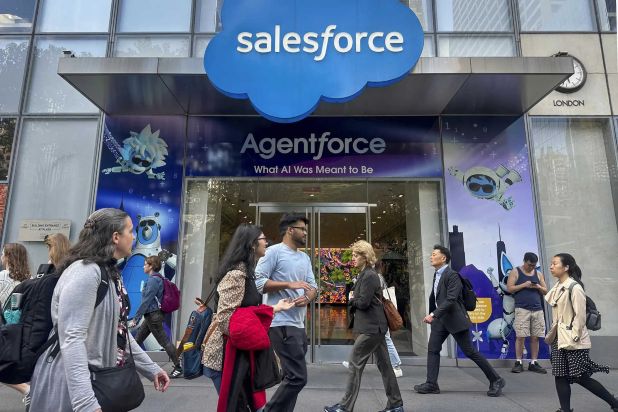
Salesforce recently cut 4,000 customer support jobs, reducing its support workforce from about 9,000 to 5,000. This move was driven by a major push to integrate AI into its support operations.
CEO Marc Benioff confirmed the layoffs were possible because AI agents, particularly Salesforce’s platform Agentforce, now handle a huge portion of routine customer interactions. AI tools are reportedly managing around 1.5 million conversations and roughly 30-50% of support tasks. The AI rollout also helped process a backlog of over 100 million uncontacted sales leads that had accumulated over decades.
Despite the layoffs, Salesforce claims customer satisfaction hasn’t suffered. AI automation, combined with a supervisor framework, allowed the company to maintain service quality. Many laid-off employees were shifted into roles in professional services, sales, and customer success, instead of being entirely cut loose.
What led up to this decision?
Salesforce introduced AI-driven tools like Agentforce earlier in 2025 to automate support workflows. By September, AI was handling half of all customer interactions.
In early 2023, Salesforce laid off around 8,000 employees (about 10% of its workforce) attributing over-hiring during the COVID-19 boom and a slowing demand environment. In January 2024, the company trimmed an additional ~700 jobs amid pressure to boost profit margins and tighten spending.
Over time, Salesforce has incrementally adopted AI, launching tools like Einstein AI, Service Agent, and later Agentforce. The September layoffs represent a significant inflection point in fully embracing an “agentic” AI model across its support organization.
 According to Salesforce CEO Marc Benioff, the technology improves productivity by handling sales leads that used to be ignored. As a result, Salesforce’s support staff has decreased from 9,000 to 5,000 employees.
On ‘The Logan Bartlett Show’, Benioff explained that AI agents are taking over customer support tasks and helping the company follow up on more sales opportunities.
“It’s been eight of the most exciting months of my career,” Benioff said. “I was able to rebalance my head count on my support. I’ve reduced it from 9,000 heads to about 5,000 because I need less heads.”
Additionally, he added that AI agents have also made the company more productive.
“There were more than 100 million leads that we have not called back at Salesforce in the last 26 years because we have not had enough people,” he said. “But we now have an agentic sales that is calling back every person that contacts us.”
Now, half of customer conversations are done by AI and half by humans. Benioff said that matters because AI sometimes needs to hand tasks back to people.
“It’s not any different than [if] you’re in your Tesla and all of a sudden it’s self-driving and goes, ‘Oh, I don’t actually know what’s happening, you take over,’ and that’s kind of the same thing,” Benioff said.
Insights:
Salesforce’s decision has raised more questions than it answers. While Benioff has framed the move as a leap toward efficiency, the immediate costs of layoffs (severance packages, lost institutional knowledge, potential reputational damage etc.) are far from negligible. Companies often overestimate the short-term savings from workforce reductions, only to face hidden expenses in rebuilding expertise and morale down the line. 262 of these jobs were in San Francisco, where Salesforce is a major employer in the area (SFGate). It can be assumed that the majority of the affected employees are located in foreign countries. Therefore, what will be the expected impact on P&L?
There’s also uncertainty around whether Salesforce’s new Agentforce platform can deliver at the scale being promised. The company claims AI agents will be able to draw on a staggering 100 million prospects accumulated over 26 years, but the reality is unclear. How realistic is it that prospects from 26, 20, 15, and even 8 years ago are still viable? Pre and post 2020 will have also shifted the landscape. Even if partly successful, what are the revenue growth expectations?
The risk is that Salesforce is betting on a vision that isn’t fully backed by operational readiness. If Agentforce fails to live up to expectations, the company may find itself having sacrificed thousands of employees, and the trust of customers, for savings that never materialize.
Vivienne Grace Bartels – Intrepid Explorers, LLC
About the author: Vivienne is a young professional with experience in business and operations and a background in politics and economics. She writes on the intersection of technology and strategy, and society, with a particular interest in how our world is changing to adapt to different economic and political forces. Vivienne can be reached at: vivienne.bartels@gmail.com
Sources: TechRadar, The Times of India, Business Insider, Al Jazeera
About Salesforce
Salesforce helps organizations of any size reimagine their business with AI. Agentforce — the first digital labor solution for enterprises — seamlessly integrates with Customer 360 applications, Data Cloud, and Einstein AI to create a limitless workforce, bringing humans and agents together to deliver customer success on a single, trusted platform. Visit www.salesforce.com for more information.
Source: capacitymedia.com