
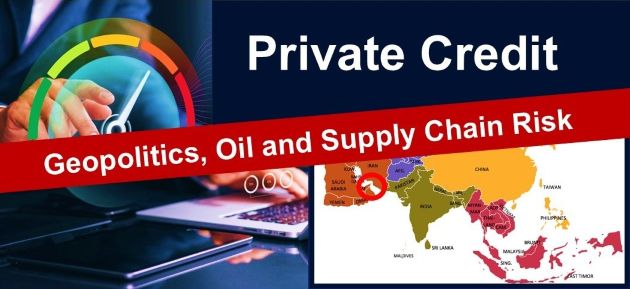
Recent headlines have amplified previous concerns about private credit.
Commentary now links redemption pressures, geopolitical tensions, and energy-market volatility into a broader narrative of potential disruption. Some observers have gone as far as suggesting the early stages of a credit crisis.
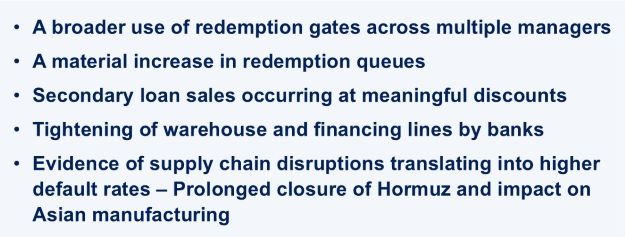
That interpretation may be premature. However it would be prudent to watch for further changes:
Recent data indicate that several billion dollars of investor capital are currently subject to withdrawal limits across parts of the private credit market. In a market exceeding $1 trillion, this is not, in itself, systemic. It does, however, reflect a change in investor behavior.
Private credit has grown rapidly over the past decade by filling a structural gap — serving borrowers that fall between bank underwriting standards and public capital markets. That role remains valid. But the model depends on stable investor capital, limited redemption pressure, and confidence in underwriting and valuation practices.
The recent shift in sentiment is testing those assumptions.
Gating mechanisms, such as those seen in individual funds, are not unusual in semi-liquid structures. They are designed to manage liquidity mismatches. However, their activation changes investor perception. Attention shifts from yield to access, and from performance to liquidity.
At the same time, broader market conditions are becoming less predictable. Geopolitical tensions, particularly those affecting energy supply routes, introduce an additional layer of uncertainty. Disruptions in upstream supply chains can translate into cost pressures, production delays, and ultimately weaker corporate cash flows. For middle-market companies — the core borrowers in private credit — such pressures can become relevant quickly.
Individually, these developments are manageable. Together, they warrant closer observation.
Private credit has not yet been tested at its current scale through a full economic cycle. What we are seeing today is best understood as an early-stage stress phase — where investor expectations, liquidity structures, and external conditions begin to interact.
The critical issue is not the presence of redemptions, but whether they broaden.
If redemption activity remains contained, the market is likely to adjust through normal mechanisms: selective asset sales, tighter underwriting, and more cautious capital deployment. If, however, redemptions expand across multiple managers while external pressures increase, the dynamic would shift. Credit availability could become more selective, and refinancing conditions for middle-market borrowers could tighten.
For now, the available evidence suggests a turning point rather than a systemic event.
Markets that expand rapidly inevitably reach a stage where investors begin asking harder questions. Private credit appears to have reached that stage.
From the perspective of those who observe credit markets through the lens of information and due diligence, this moment may ultimately prove constructive. Periods of heightened scrutiny tend to reinforce discipline — encouraging more rigorous verification, deeper analysis, and stronger monitoring of underlying exposures. The need for information generally grows in an era of uncertainty.
The coming months will be important — not because a crisis is assured, but because the signals now emerging will determine the direction of the cycle.
As we said at the beginning “What to watch closely”:
- A broader use of redemption gates across multiple managers
- A material increase in redemption queues beyond current levels
- Secondary loan sales occurring at meaningful discounts
- Tightening of warehouse and financing lines by banks
- Evidence of supply chain disruptions translating into higher default rates
These indicators, taken together, would suggest that stress is moving from isolated cases toward broader market impact.
Until then, the situation remains one of heightened attention rather than confirmed disruption.
 Sources: Commentaries by Bloomberg, Financial Times, Economictimes.Indiatimes.com, Armada Corporate Intelligence and Intrepid Explorers Research supported by ChatGPT