
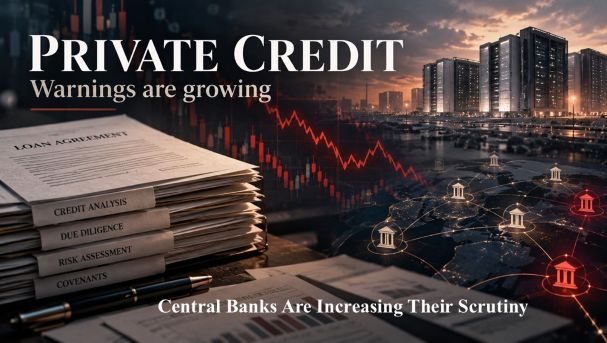
 If you ask me why Central Banks are increasing their scrutiny of Private Credit: “They fear that the vulnerabilities which are accumulating across interconnected lending and investment markets, potentially creating the conditions for another financial crisis.”
Central banks are increasingly examining vulnerabilities in private credit and AI infrastructure financing.
Investor redemption pressures, concerns about underwriting quality and growing financial interconnections are attracting international regulatory scrutiny. Yet important questions remain:
- Was independent commercial credit information adequately used when these loans were originally underwritten?
- What role did credit rating agencies play?
- And is the business information industry now sufficiently engaged in identifying emerging risks?
Central Banks Are Increasing Their Scrutiny
The Financial Stability Board’s (FSB) May 2026 report identified vulnerabilities in private credit, including borrower credit quality, opaque valuations, liquidity mismatches and expanding relationships among private-credit funds, banks, insurers and private-equity firms. The FSB also acknowledged substantial information gaps that complicate the assessment of financial exposures and potential transmission risks.
On October 16, the Federal Reserve published its initiative to identify private credit separately within the US Financial Accounts. This represents an important step toward improving visibility into lending arrangements that have historically been difficult to measure.
The Reserve Bank of Australia’s October Financial Stability Review highlighted continuing redemption pressures. During the June quarter, US non-traded private-credit funds received more than $15 billion in redemption requests, approximately 60% of which remained unfulfilled at the end of June.
Redemption restrictions have so far helped limit forced asset sales. Nevertheless, they expose the difficulties of offering periodic liquidity to investors while holding relatively illiquid loans.
On October 23, the Bank of Japan added another dimension.
Its Financial System Report examined how declining expectations for AI infrastructure profitability could trigger portfolio adjustments among foreign nonbank financial intermediaries and transmit financial shocks to Japanese banks.
The Bank concluded that Japan’s financial system remained resilient under the scenarios examined. Nevertheless, its analysis demonstrates increasing attention to the interconnectedness of AI financing, nonbank lenders and traditional banking institutions.
AI Infrastructure Adds Another Dimension
AI infrastructure expansion requires substantial financing for data centers, computing equipment, energy supply and associated facilities. Private lenders, banks and institutional investors are increasingly involved in financing these investments.
The underlying risks include uncertain future revenues, dependence on major technology customers, asset valuations and refinancing obligations.
An adverse reassessment of AI profitability could affect borrowers, lenders and investors simultaneously.
The question is whether these financial relationships and their associated risks are sufficiently transparent to the institutions responsible for assessing them.
The Due-Diligence Question
In earlier Intrepid Explorers articles, particularly The Information Paradox in Private Credit (March 2, 2026), I questioned why shortcomings in underwriting and independent verification continued to emerge despite the availability of sophisticated commercial credit-information infrastructure.
The collapse of First Brands Group, together with other borrower failures, raised questions about collateral verification, related-party transactions and complex financing structures.
This brings us to a fundamental question:
To what extent was independent commercial credit information incorporated into the underwriting and due-diligence processes supporting the expansion of private credit?
Were corporate relationships, beneficial ownership, payment histories and supplier-financing arrangements adequately investigated?
Were warning signals unavailable, overlooked or insufficiently integrated into credit decisions?
We should not assume that the information industry failed. Equally, we should not assume that its capabilities were fully employed.
What About the Credit Rating Agencies?
Another question concerns the role of credit rating agencies.
Unlike publicly traded corporate debt, many privately negotiated loans have no published agency rating. Some receive confidential ratings or credit estimates, while others rely primarily on internal assessments by lenders and investment managers.
This raises questions about independent credit-risk evaluation, consistency and transparency.
To what extent were rating agencies involved in the original financing decisions, and how effectively have subsequent changes in borrower creditworthiness been monitored? There are signs that the information gap is attracting greater attention.
On October 1, Moody’s Analytics and Allvue introduced a private-credit risk model designed to identify deterioration through indicators including covenant waivers, loan amendments and payment-in-kind arrangements before formal default.
This is not a conventional agency credit rating. Rather, it illustrates how specialized private-market data and analytical models are being combined to improve credit-risk monitoring.
A privately held loan is not necessarily independently rated. Even where an assessment exists, its usefulness depends on the quality, independence and timeliness of the underlying information.
The Early-Warning Question
A further question concerns the detection of deteriorating borrower conditions after loans have been made.
- Businesses experiencing cash-flow difficulties may continue servicing financial debt while extending payment terms to suppliers.
- Changes in commercial payment behavior could therefore provide warnings before formal loan delinquency becomes evident.
- Credit-information companies have accumulated considerable experience in collecting and analyzing precisely this kind of information.
- Could comparative payment trends, corporate linkage information and independent borrower monitoring contribute to a more effective early-warning capability?
- And could common legal-entity identifiers help connect information across financial institutions, investment funds and commercial databases?
These possibilities require further research and empirical validation.
A Challenge for the Business-Information Industry
Private credit has not produced a generalized financial crisis. Central banks continue to distinguish vulnerabilities affecting particular borrowers and investment vehicles from systemic financial instability.
Nevertheless, the accumulation of credit-quality concerns, investor liquidity pressures and increasingly complex financial interconnections deserves serious attention.
For the business-information and credit-rating industries, three questions deserve answers:
- Was independent commercial information adequately incorporated into the original underwriting and due-diligence processes?
- What role did independent credit ratings and credit-risk assessments play, and how consistently were they updated?
- Could commercial payment behavior, corporate relationships and borrower-performance information provide earlier warnings of financial deterioration?
These questions concern the quality of information available to lenders, its independent assessment and its effective use throughout the credit cycle.
The answers matter to lenders, investors, regulators and potentially to the wider financial system.
Credit and information are intertwined
Addendum: What Is Private Credit?
In financial-market and regulatory terminology, private credit generally refers to privately negotiated loans to businesses originated by nonbank investment funds rather than traditional banks.
This is broadly consistent with the definition employed by the Federal Reserve in its October 16, 2026 research note.
Private credit commonly includes direct corporate lending and may also encompass privately originated asset-backed, infrastructure and real-estate financing arrangements.
Its characteristics often include limited public disclosure, negotiated lending terms, relatively illiquid assets and less frequent market-based valuations.
Private credit should not be confused with consumer credit reporting, personal credit scores or the confidentiality of consumer credit information.
For financial regulators, the principal concerns include borrower creditworthiness, leverage, liquidity mismatches, valuation practices and interconnections with banks, insurers and other financial intermediaries.
Sources and Further Reading
- Financial Stability Board — Report on Vulnerabilities in Private Credit, May 6, 2026
- Federal Reserve — Introducing Private Credit into the Financial Accounts of the United States, October 16, 2026
- Reserve Bank of Australia — Financial Stability Review, October 2026
- Bank of Japan — Financial System Report, October 23, 2026
- Moody’s — Developing a Shared View on Private Credit Risk, October 2026
- Intrepid Explorers — The Information Paradox in Private Credit, March 2, 2026
- Intrepid Explorers — First Brands Group: Private Credit’s Wake-Up Call, January 11,
 2026
 2026
Intrepid Explorers, LLC ongoing research supported by ChatGPT