
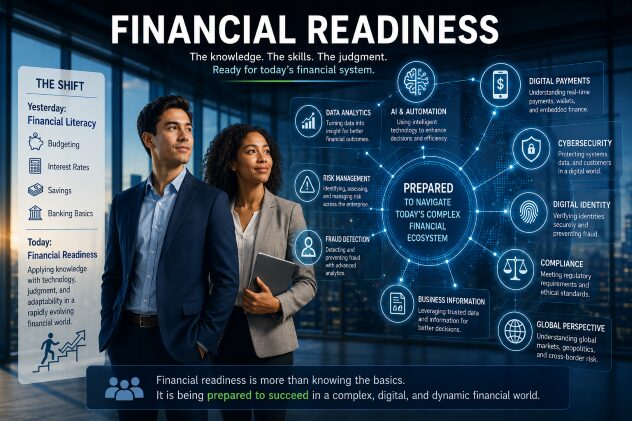
A recent Bloomberg commentary by Allison Schrager raised an important question that deserves the attention of the entire financial services community.
“Financial illiteracy, she observed, cuts across generations and income groups, while financial education has failed to keep pace with an increasingly complex financial system.”
Bloomberg is not alone in sounding this warning. Over the past decade, researchers, regulators, and financial institutions have reached remarkably similar conclusions. The concern is no longer simply that Americans lack financial knowledge; it is that the financial system itself is evolving faster than the educational structures designed to prepare people for it.
The evidence is becoming difficult to ignore. The 2026 TIAA Institute–Stanford Global Financial Literacy Excellence Center (GFLEC) Personal Finance Index reports that U.S. adults correctly answered only 47 percent of basic financial literacy questions—the lowest score recorded since the survey began ten years ago. Gen Z averaged only 38 percent, while one-quarter of American adults now fall into the category of “very low financial literacy.” Particularly concerning is that comprehension of financial risk scored lowest of all measured categories, with only 36 percent of risk-related questions answered correctly.
These findings should not be viewed merely as another discussion about personal finance. They represent an early warning signal for the financial services industry itself.
Perhaps the time has come to broaden the discussion. Rather than focusing solely on financial literacy, we should begin talking about financial readiness.
Financial literacy measures what people know. Financial readiness measures whether they are prepared to function successfully within today’s financial system.
That distinction is becoming increasingly important because the financial services industry has changed beyond recognition. A generation ago, a young professional entering banking, insurance, commercial credit, or financial services required a solid understanding of accounting, lending principles, credit analysis, and customer relationships. Those skills remain essential, but they are no longer sufficient.
Today’s financial professional enters an environment shaped by artificial intelligence, digital payments, embedded finance, cybersecurity, identity management, anti-money laundering regulation, sanctions compliance, data governance, fraud prevention, cryptocurrencies, and rapidly evolving regulatory frameworks. Modern finance has become an ecosystem in which finance, technology, regulation, and information management continuously intersect. Yet much of our educational thinking continues to reflect the financial world of twenty years ago.
This widening gap between technological change and educational preparation should concern not only universities but also employers, regulators, and professional associations. It also raises an important question for the business information industry, whose very purpose has always been to reduce uncertainty and improve decision-making through trusted information.
The encouraging news is that parts of the industry have already recognized the challenge. Organizations such as the Consumer Data Industry Association (CDIA) have developed education covering consumer credit reporting, regulatory compliance, privacy, and consumer protection. The National Association of Credit Management (NACM) has, for many decades, provided professional education in commercial credit, collections, credit risk management, and one of the profession’s most valuable traditions—the Credit Group—where practitioners openly exchange collection experiences, discuss emerging risks, and share practical solutions. Banking organizations, fraud prevention specialists, compliance institutes, and other professional bodies have similarly invested in continuing education because they recognize that learning cannot end with a university degree.
These initiatives deserve recognition. They demonstrate that the industry understands the challenge. At the same time, they also reveal another reality. Professional education remains fragmented. Consumer credit, commercial credit, banking, compliance, fraud prevention, payments, financial technology, and cybersecurity each tend to educate within their own disciplines. As financial services become increasingly integrated, there is an opportunity for greater collaboration in preparing future professionals for the interconnected nature of modern finance.
This is not an argument that universities have failed. Nor is it a criticism of teachers. Rather, it reflects the extraordinary speed at which financial services have evolved. Educational institutions face the difficult task of preparing students for professions that continue to change almost as quickly as technology itself. No curriculum can remain static when artificial intelligence, digital identity, cyber risk, and regulatory change are constantly reshaping the financial landscape.
The business information industry has always adapted to changing markets. From commercial credit reporting to digital identity, from payment information to advanced risk analytics, it has consistently transformed data into information and information into better decisions.
 If you ask me, perhaps its next contribution should be to help develop the next generation of financial professionals by working more closely with universities, employers, regulators, and professional associations to strengthen financial readiness.
The latest TIAA–GFLEC research provides one final reason why this matters. Workers with very low financial literacy spend nearly eleven hours each week dealing with personal financial concerns while at work. Financial readiness, therefore, is no longer simply an educational issue. It has become a workforce issue, a productivity issue, and ultimately an economic competitiveness issue.
Bloomberg’s warning should therefore be viewed as more than an interesting commentary. It is an invitation for the financial services community to ask whether we are preparing tomorrow’s professionals for yesterday’s financial system—or for the one they will actually inherit.
For the business information industry, that question deserves careful consideration. The industry’s mission has always been to transform information into better decisions. Helping transform financial literacy into financial readiness may well become one of its most valuable contributions to the future of financial services.
As we have often observed, Data is not Information. Information is not Knowledge. Knowledge is not Judgment. In the financial world of tomorrow, judgment will increasingly depend upon readiness.
 Source: Bloomberg, TIAA Institute–Stanford Global Financial Literacy Excellence Center (GFLEC) Personal Finance Index, Intrepid Explorers, LLC supported by ChatGPT