

Europe’s AML System at a Structural Inflection Point – In Plain Language it Seems to Be no Longer Working!
What is at fault: Outdated Complience Systems/Platforms, Access to Information; or Disfunctional Risk Management; or a Combination of all Three? Why the shift from volume to intelligence is no longer optional?
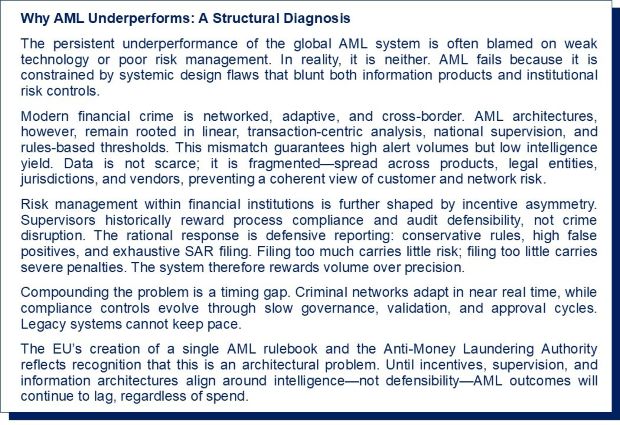
- AML has not failed because of bad intentions or incompetence. It has failed because it was never redesigned for networked finance.
- AML Crime continues to flourish because financial crime has evolved into a networked, cross-border system, while compliance architectures—both technological and institutional—remain fragmented, incentive-misaligned, and historically rule-driven.
- AML fails because it is constrained by systemic design flaws that blunt both information products and institutional risk controls.
 For more than a decade, Europe has responded to financial crime with ever-expanding rulebooks, rising compliance budgets, and an industrial-scale production of suspicious activity reports (SARs). Yet the uncomfortable reality is now widely acknowledged: more reporting has not translated into better outcomes. Intelligence yield remains low, law-enforcement conversion rates are weak, and financial crime networks continue to exploit cross-border fragmentation and legacy detection models.
This is not a marginal problem. The Financial Action Task Force (FATF) has repeatedly found that the overwhelming majority of jurisdictions—97% of assessed countries—achieve only low to moderate effectiveness in preventing money laundering and terrorist financing. European FIUs themselves report that only a small fraction of millions of annual reports result in actionable intelligence, let alone prosecutions or asset recovery. The system is busy, expensive, and procedurally compliant—yet strategically underperforming.
The reasons are structural. Europe’s AML framework evolved in a world dominated by rules-based monitoring, siloed customer data, and nationally bounded supervision. That architecture struggles with today’s reality: networked crime, correspondent banking chains, instant payments, and crypto-asset flows that move faster than human review cycles. Rule tuning and manual investigation cannot scale indefinitely, and defensive over-reporting has become a rational—but ultimately self-defeating—institutional response.
Recognizing this, the European Commission has launched the most ambitious overhaul of the AML regime in EU history. The new “single rulebook,” centered on the AML Regulation and AML Directive, replaces fragmented national transposition with directly applicable obligations. Even more consequential is the creation of the Anti-Money Laundering Authority (AMLA), headquartered in Frankfurt, which will begin operations in 2025 and assume direct supervision of selected high-risk, cross-border institutions from 2028 onward.
This is not simply regulatory consolidation. AMLA represents a shift in supervisory philosophy: from formalistic compliance toward demonstrable effectiveness, comparability across institutions, and EU-level accountability. In parallel, the EU’s Artificial Intelligence Act classifies transaction monitoring, sanctions screening, and customer risk assessment as high-risk AI use cases. The message is clear: advanced analytics are no longer optional, but neither are transparency, governance, and human oversight.
It is at this intersection—higher AML expectations and stricter AI governance—that the industry faces a defining choice. Studies such as the recent ThetaRay analysis by Andrea Minto and Yaron Hazan argue persuasively that legacy rule-based systems cannot meet the new standard. High false-positive rates, poor network visibility, and weak alert-to-intelligence conversion will become supervisory vulnerabilities under the AMLA regime. At the same time, “black-box AI” deployed without robust controls will fail under the AI Act’s requirements for explainability, lifecycle management, and accountability.
The direction of travel is unmistakable. Europe is moving toward intelligence-led AML: fewer but higher-quality alerts, network-aware detection, integrated customer and transaction views, and auditable human-AI decision frameworks. For financial institutions and the information industry alike, the question is no longer whether AI will be used in AML—but whether it will be used responsibly, transparently, and effectively enough to satisfy both supervisors and society.
In that sense, Europe’s AML system is not merely “under strain.” It is at a structural inflection point—where technology capability, regulatory obligation, and public trust are becoming inseparable.
 Sources: This research was triggered by a recent article: Europe’s AML system at ‘breaking point’ as incoming regulations make AI adoption inevitable; Intrepid Explorers, LLC initiated additional research aided by ChatGPT