
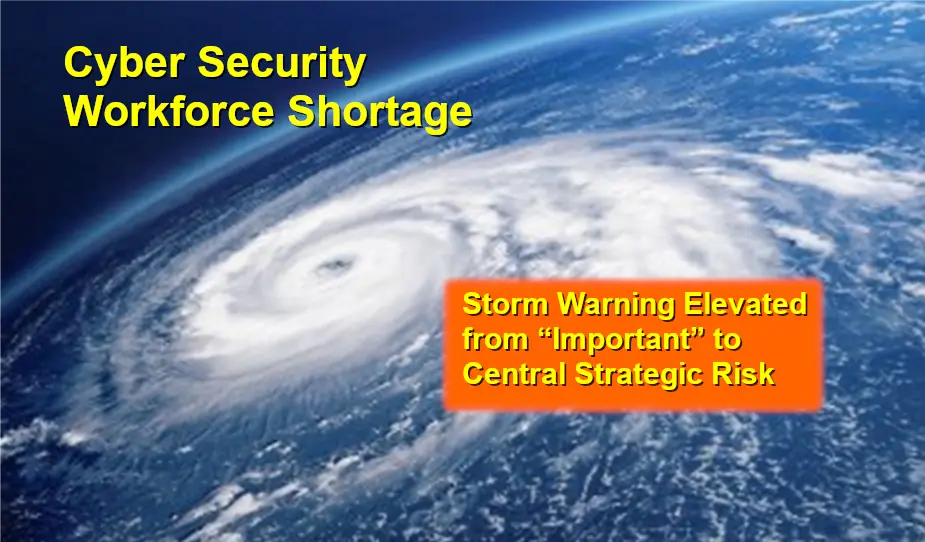
For years, cybersecurity workforce shortages have been described as a constraint, a bottleneck, or an unfortunate but manageable side issue. That framing is now dangerously outdated.
We have written about the issues back in November 2025 “Converging Threats are Creating a Perfect Storm”
What has changed is not merely the scale of cyber threats, but the speed and asymmetry with which they are evolving. Artificial intelligence has compressed attack timelines, lowered barriers to entry for cybercriminals, and industrialized fraud and disruption. Meanwhile, the global supply of skilled defenders has failed to keep pace. The result is no longer a gap — it is a structural imbalance.
From Skills Gap to Strategic Vulnerability
Recent global outlooks from the World Economic Forum, ISACA, ENISA, and ISC² converge on a stark conclusion: the cybersecurity workforce shortage has moved from an operational concern to a central strategic risk.
Estimates now place the global shortfall at 8 million professionals, concentrated in precisely the roles most critical to modern defense: incident response, threat hunting, AI governance, cloud security, and operational resilience. This shortage is no longer confined to developing markets or small organizations; it now affects critical infrastructure, healthcare systems, financial institutions, and government agencies alike.
Why This Matters Now
AI has fundamentally altered the economics of cybercrime. Attackers innovate faster, scale cheaper, and operate with increasing autonomy. Breakout times have shrunk from days to hours — sometimes minutes. Defensive success increasingly depends on human judgment, not just tooling: prioritization, escalation, governance, and decision-making under pressure.
Yet security teams are:
- understaffed,
- overstretched,
- experiencing chronic fatigue,
- and increasingly reliant on automation they do not fully govern.
This creates a paradox: more tools, more data — but fewer people capable of converting either into effective defense.
Technology Cannot Compensate for Missing Humans
Recent investments have focused heavily on AI, XDR, automation, and telemetry. These are necessary — but not sufficient. Tools amplify capability; they do not replace it. Without skilled professionals to configure, supervise, and adapt them, advanced platforms risk becoming noise generators rather than force multipliers.
In effect, the workforce shortage is now acting as a force multiplier for attackers. Every unfilled role lengthens detection times, weakens response coordination, and increases the likelihood that incidents escalate from contained breaches into systemic disruption.
A Narrow Window for Action
The next two to three years are likely decisive. If governments, regulators, and industry leaders fail to:
- scale national cyber talent pipelines,
- modernize training and certification pathways,
- embed AI governance as a core skill,
- and treat workforce development as national infrastructure,
then the imbalance between attacker capability and defender capacity risks becoming structurally irreversible. At that point, no amount of regulation, tooling, or insurance will compensate for the absence of human expertise.
Conclusion: Time Is No Longer on Our Side
Cybersecurity is no longer constrained primarily by technology or budget. It is constrained by people.
The workforce shortage has been elevated from “important” to central strategic risk — one that underpins AI governance, fraud prevention, operational resilience, and national security itself. Incremental responses will not close this gap. What is required now is urgency, coordination, and strategic clarity — before speed, scale, and automation permanently tip the balance in favor of adversaries.
 Sources: Intrepid Explorers, LLC Research Supported by ChatGPT; Cyber Security Intelligence
Also read: Cyber Security Trends: Converging Threats are Creating a Perfect Storm, Nov 29, 2025