
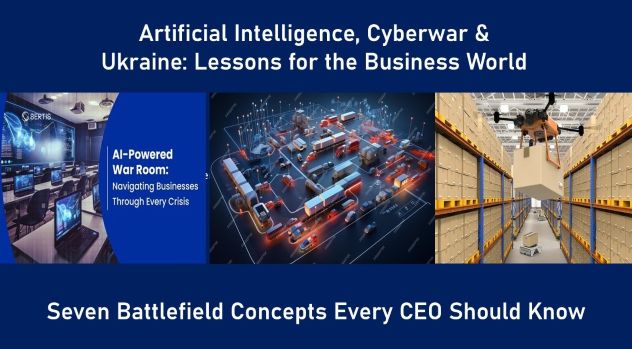
Enter AI and Cyberwarefare on the battle field and quickly a new form of warfare emerges. Such a new war is now being fought in the Ukraine.
Preamble: Business strategists are watching with interest whether some of the AI / Cyber strategies and tactics are useful in business. This idea is not far fetched.
In the 1980’s, while attending a two week international business strategy course at Columbia University, I learned how to use some principles of warfare in business: Carl von Clausewitz (on War) taught that in attacking an opponent directly one had to have 3 to 1 advantage. In applying this principle to business means a 3 to 1 advantage in marketing, manufacturing, logistics and working capital.
Mao in his principles of guerilla warfare used foreign support first before committing his own resources. Also when a victory was not imminent, he disengaged, but left some elements behind ‘under ground’. His concept was, leave one man behind, it will bind 7 of the opposition. In marketing terms: Don’t exit a market completely. Retain a foothold, the experience will be valuable in an eventual full reentry. The competition will be required to spend resources to defend the home turf, which cannot be deployed elsewhere.
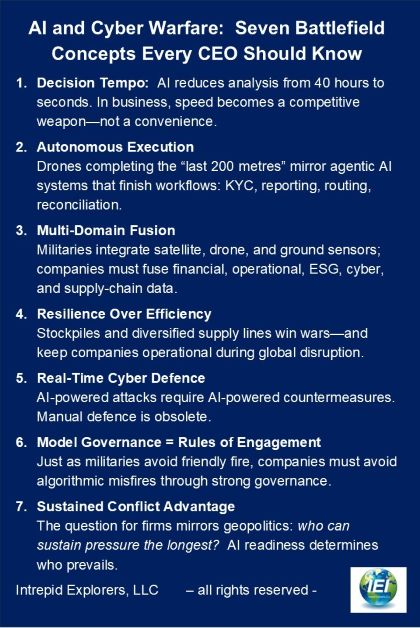
Whithin this context the story below may be of interest to you, and its comparison illustrated in the sidebar “the Seven Battlefield Concepts Every CEO Shoud Know! [sidebar]
 The Makings of a New Warfare in the Ukraine
The slow-motion Russian invasion of Ukraine has highlighted persistent vulnerabilities in Western military readiness, specifically concerning munitions stockpiles, supply chain resilience, and procurement agility. As the conflict continues, nations are adjusting their force posture and defence planning. These changes aim not only to support Ukraine but also to prepare for the realities of prolonged, multi-domain warfare.
While quantum computing and automation are shaping the next stages of military evolution, Artificial Intelligence (AI) is already altering tactical outcomes on the ground. The central question remains which nations can sustain war over extended periods.
Impact on combat In Ukraine, AI is fundamentally changing how battles are fought. The technology is now integrated directly into lethal drones that patrol the front lines, scanning terrain and processing video feeds to locate enemy positions. Integrated computing systems analyse this footage in real time, identifying vehicles, trenches, and targets almost instantly, even in environments where communications are jammed (Cyber Security).
Speed in Decision Making: Tasks that previously required 40 hours of human analysis can now be completed in seconds. This acceleration has significantly increased the pace of combat. Both Russian and Ukrainian forces are testing and deploying AI for target acquisition, intelligence gathering, and de-mining operations.
Strategic Benefits: For Ukraine For the Ukrainian Army, AI-enabled technology is viewed as a vital tool for enhancing strategic planning, optimising resources, and preserving the lives of personnel. However, its most profound effect is visible in unmanned weapons systems. Ukrainian troops currently use AI-based software that allows drones to lock onto a target and fly autonomously for the final few hundred metres of an attack. This terminal guidance capability makes electronic jamming ineffective and renders the small flying objects difficult to shoot down.
Ultimately, these systems are expected to evolve into fully autonomous weapons capable of finding and destroying targets independently, requiring only a simple command from an operator.
Risks & Ethics: Automation extends to defence as well as offence. Interceptor drones equipped with AI could significantly strengthen air defences against Russian long-range attack drones, such as the Shahed series. Projections suggest that thousands of such systems could be operational by the end of 2026. Despite this potential, Ukrainian developers express caution regarding defence systems that rely entirely on AI without human oversight.A significant risk is the potential for fratricide;AI systems may fail to distinguish between Ukrainian and Russian soldiers, particularly given the similarities in uniforms. Furthermore, there are concerns that fully automated systems could violate the rules of war. The ability of algorithms to reliably avoid harming civilians or to distinguish between combatants and non-combatants is a highly contentious issue.
As the two sides remain locked in bloody attritional warfare, technological innovation appears to be the primary area of rapid progression.

 Cyber Security Intelligence and research by Intrepid Explorers, LLC. supported by ChatGPT.