
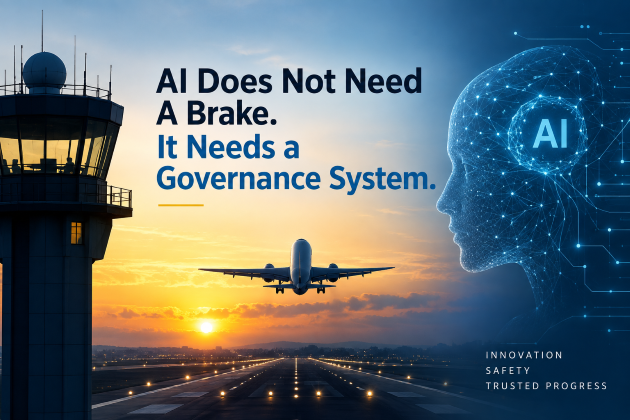
 If you ask me, the debate over slowing down artificial intelligence may be asking the wrong question.
Some AI industry leaders are warning that increasingly powerful models may need to be developed more slowly. Others argue that slowing development could sacrifice innovation and strategic advantage, particularly as technological competition between the United States and China intensifies.
There is another choice.
Do not slow AI innovation. Accelerate the governance infrastructure around it. And governance must begin before deployment—not primarily with audits after something has gone wrong.
Aviation Offers a Useful Model. Aviation provides a useful comparison, not because an aircraft and an AI model are technically alike, but because aviation learned how to govern rapidly advancing technology where failures can have serious consequences.
We did not stop building faster aircraft. Instead, an infrastructure developed around innovation.
Aircraft and critical components must meet standards and undergo testing and certification before entering service. Pilots, mechanics and controllers require training and qualification. Operations are subject to rules. Equipment is inspected and maintained. Certain components have defined service lives. Incidents must be reported. Accidents are independently investigated. Qualifications and certifications must be renewed.
The sequence matters:
Standards → Qualification → Stress Testing → Certification → Deployment → Monitoring → Audit → Incident Investigation → Recertification.
Audit is essential. But audit comes after standards have established what should have happened. AI increasingly needs the equivalent.
The Industry Is Beginning to Ask the Same Question
 Long-time information-industry observer David Worlock recently raised concerns about the auditability of AI developers and whether voluntary testing arrangements provide sufficient independent scrutiny. His broader concern is important: If an AI company can decide for itself whether an independent evaluator is allowed to test its system, when the testing occurs, and how much access the evaluator receives, then the evaluation is not fully independent.
 The issue has also reached Washington. Senator Richard Blumenthal has asked OpenAI to answer questions following reports concerning autonomous AI agents and the circumstances surrounding independent examination of a cybersecurity incident. These are questions and allegations under inquiry, not established findings. But they raise an important governance issue: Who audits the developer—and against what independently established standards?
That question does not begin with audit. Before an auditor can determine whether an organization complied, someone must establish the requirements against which performance is measured.
For AI, that raises much earlier questions.
Which systems require independent testing before deployment? What constitutes an acceptable stress test? Who certifies the system? Who qualifies the people conducting the evaluation? What standards govern the data upon which the system relies? When does a material change to a model require reevaluation? What incidents must be reported? Who investigates a failure?
These are governance questions—not arguments against innovation.
The Good News: Parts of the System Already Exist
Aviation was initially a useful metaphor for thinking about AI governance. It is increasingly becoming a useful model for thinking about the emerging governance architecture. It is increasingly becoming a useful way of thinking about an emerging governance architecture.
ISO/IEC’s SC 42 is already developing international AI standards covering areas including data, trustworthiness, risk management and conformity assessment. ISO/IEC 42001 provides an AI management-system standard, while additional work addresses the bodies that audit and certify such systems and conformity-assessment schemes for AI systems.
In the United States, NIST’s Center for AI Standards and Innovation (CAISI) is working with industry on AI testing, evaluation, security and standards. NIST is also working on standards for autonomous AI agents and on the difficult problem of monitoring AI after deployment.
Singapore offers another interesting example. Through IMDA and the AI Verify Foundation, it is developing practical testing and assurance mechanisms, including accreditation of AI testers.
Europe is constructing its own regulatory and conformity architecture around the EU AI Act, supported by CEN-CENELEC and other standards organizations.
The pieces therefore exist. The challenge is connecting them into a coherent governance system.
Trusted Data Remains Part of the Foundation
There is another lesson that should be familiar to the information industry.AI can process enormous quantities of information at extraordinary speed. But processing more information does not automatically make unreliable information reliable.
Trusted decisions still depend upon trusted data, provenance, identity, verification, cybersecurity and human judgment.
Humans will also remain necessary to challenge output.
Experienced professionals often recognize an improbable result because they understand the industry, the customer, the underlying data or the economic environment. AI can greatly improve their ability to analyze information, but governance must determine when human review remains necessary and who is qualified to perform it.
This is particularly important as AI moves from answering questions to taking autonomous actions.
Speed Versus Safety Is the Wrong Choice: The geopolitical problem cannot be ignored.
AI development has become part of an intensifying strategic technology competition, particularly between the United States and China. A unilateral decision to slow innovation does not mean competitors elsewhere will do the same.
That makes effective governance more urgent, not less.
The objective should therefore not be to put a brake on technological development. It should be to build the equivalent of aviation’s surrounding safety infrastructure quickly enough to keep pace with innovation. Government does not need to design the AI model any more than an aviation authority needs to design an aircraft.
But government, standards organizations, industry and independent experts need to determine what must be demonstrated before critical systems are deployed, who is qualified to make that determination, and how continuing compliance is verified.
Aviation did not choose between innovation and governance. It institutionalized both. AI should be capable of doing the same.
 Source: AI Governance News, Worlock, Blumenthal, Intrepid Explorers, LLC supported by ChatGPT
Also Read: Autonomous AI needs a control tower