
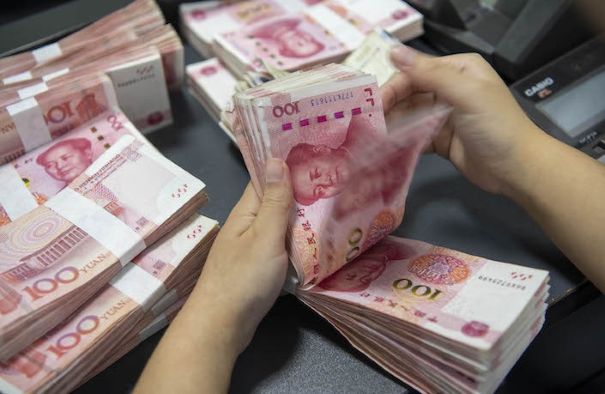
Eligible consumption loans will receive a 1 percentage point interest subsidy from Sept. 1, 2025, through Aug. 31, 2026.
China launched a yearlong program to subsidize household consumer loans, part of a nationwide effort to cut borrowing costs and spur spending as policymakers seek to revive demand.
Under the plan, announced by the Ministry of Finance and two other agencies, residents who take out loans at 24 designated financial institutions will receive a 1 percentage point interest subsidy from Sept. 1, 2025, through Aug. 31, 2026. The policy excludes credit cards and is limited to loans that can be verified as used for consumption.
Eligible spending includes loans under 50,000 yuan ($6,870) for general consumption, and larger-ticket purchases such as automobiles, elder care, education, tourism, home renovations, electronics and medical services.
The subsidy rate is capped at 1% annually and cannot exceed 50% of the contracted loan interest rate. Each borrower may claim a maximum subsidy of 3,000 yuan ($410) during the program, with a 1,000 yuan limit on small-ticket loans under 50,000 yuan.
On the first day of the rollout, Caixin reporters found bank branches in Beijing largely prepared, with staff trained to answer questions, though some admitted they were still learning the process. Several lenders said that after subsidies, consumer loan rates could fall as low as 2%.
Bankers explained that for smaller loans, systems can automatically verify merchant information and apply the subsidy, sparing borrowers from additional paperwork. Larger loans, however, may require invoices and manual review at branches, a process some warned could prove cumbersome.
A deputy branch manager at a major state-owned bank said borrowers must sign disclosure documents authorizing the bank to verify consumption data. “Once the system recognizes the merchant, 1 percentage point of interest is automatically deducted,” he said, adding that cash withdrawals are not eligible for the subsidies.
At another joint-stock bank, a customer manager said most consumer loans taken after Sept. 1 qualify. Before subsidies, loan rates typically ranged between 3% and 3.2%. With subsidies, the effective rate drops to 2% to 2.2%, depending on the borrower’s credit record. Borrowers generally must spend within 30 days of disbursement to qualify, though banks noted the rules are still being refined.
Bank executives said the program could meaningfully support consumer credit. Postal Savings Bank of China’s retail banking head Liang Shidong said the bank had rolled out training and system upgrades to ensure smooth implementation, calling the policy “a positive driver” for retail lending.
Wang Jun, assistant to president of Ping An Bank, said the bank quickly set up internal task forces to adapt its processes. “We see this as an opportunity to expand consumer lending in areas such as home renovation and medical care,” he said.
The program covers China’s six big state-owned banks, 12 joint-stock lenders including China Merchants Bank, and six consumer finance companies such as WeBank. City commercial and rural banks were excluded from the list, leaving some concerned about losing market share.
Bank of Hangzhou vice president Chen Lan said the exclusion poses a major challenge. “Without access to subsidies, we face widening rate gaps and risk losing customers to larger banks,” he said.
Chen argued that consumer and small-business loans are vital for local economies and core business for city banks. He said Bank of Hangzhou has introduced its own fee cuts and discounts to sustain demand and is lobbying local governments to provide similar fiscal support.
 Contact reporter Denise Jia (huijuanjia@caixin.com)
Source: Caixin Global